lowkenuinely discussing Gen Z slang
Gen Z slang does exist. Those who hate it, I feel, can’t come to terms with becoming out of touch with the side of the internet dominated by minors and college-age users. Nothing to be ashamed of, really. Language changes constantly, and slang is one of the fastest-moving parts of language.
Gen Z slang also exists in every language, not just English. Denial of that fact is just ignorant and anglocentric. Younger speakers always develop new vocabulary and inside jokes.
What I take issue with is mischaracterizing a real dialect of English as “Gen Z slang.”
Words like:
- Vibe
- Big back
- Unc
- Slay
- Shade
- Tea (“spill the tea”)
- Werk
- Serving
- Ate/Eating (“The outfit is eating”/ “that outfit ate”)
- Reading [someone]
- Clocking [someone]
These are not inventions of Gen Z. Many of these words come from African American English (AAE), Ballroom English, or a mixture of both. Long before the internet.
Ballroom culture is an LGBTQ+ subculture often centered in cities like New York. It is a very diverse community with folks of all races, but founded by Black and Latino folks back in the 70s.
Black Americans have produced a huge amount of mainstream viral video content. That is how these words spread to populations that would otherwise not acquire them naturally through face-to-face interaction.
You CAN use these words, anyone can! But using them incorrectly in front of the communities that use these dialects natively might get you a side eye.
Let’s highlight an actual piece of Gen-Z Slang
"lowkirkenuinely"
Modern slang.
Here is the breakdown of the word:
[LOWKEY] + [KIRK] + [GENUINE] + [LY]
Lowkey (adverb)  — originally meaning “subtly or quietly,”
                   now often used online to mean “kinda.”

Kirk (noun)      — from Charlie Kirk, an American
                   right-wing political "debater".

Genuine (adj.)   — “truly what something is said to be;
                   authentic.”

-ly (affix)      — suffix meaning “in a certain manner”.
Lowkenuinely is already a slang word. The [-kirk-] was added afterwards.
In morphology (the study of how words are built from smaller parts), we call this type of insertion an infix.
An infix is a morpheme (the smallest meaningful unit within a word) placed inside a word instead of at the beginning or end. It is a type of affix (suffix, prefix, infix). In this case, it's specifically an expletive infix.
The root word here is: Lowkenuinely (no kirk)
Why isn’t [KIRK] the root even though it's in the middle?
Because the base meaning of the word is not “Kirk.” The meaning comes from lowkey + genuinely. The inserted word only adds emphasis.
Lowkenuinely itself is a portmanteau. A portmanteau is a word formed by blending two existing words together.
Examples of portmanteaus include:
- Podcast (iPod + broadcast)
- Vlog (video + log)
- Brunch (breakfast + lunch)
Portmanteaus become words on their own once people start using them.
Expletive infix examples
You have probably heard of infixes in English before:
Fan-fucking-tastic! (USA)
or
Abso-bloody-lutely! (UK)
The inserted word acts as an intensifier. It increases emphasis without changing the core meaning.
The insertion of Kirk works the same way:
Low-kirk-enuinely
Here “kirk” functions as the expletive element. It intensifies the meaning of the root, the same way “fucking” does in the earlier example.
Why was Charlie Kirk used as an expletive?
The answer is simple: Because many people didn't like him, especially young people. Or didn't care about him. This is not new or unique to the younger generations. However, Kirk was not nearly as influential as actual politicians who've had things named after them, like Joseph R. McCarthy.
Also, his last name fits perfectly as the K in ['k]irk is the same K sound in low['k]ey. It rolls off the tongue better than "low-charl-enuinely"
Another example of this kind of formation is the word "Joever / jover."
[JOE] + [OVER]
“Joe” refers to Joe Biden, while “over” comes from the phrase it's over.
The word is used when something has gone completely wrong.
It originated on 4chan (ew) and later spread through Twitter. This is a bit special as the meaning of the word/phrase has to do with people's perception of him as a politician. Kirk was just a guy with a mic, so no special meaning associated with his name.
Note: I use "joever" all the time. It's fun to say.
Escalation
What Gen Z loves to do is take something that already looks messy and push it to absurd levels for humor.
They stack multiple blends and affixes together until the result is barely understandable. This is the most entertaining time to be a linguist.
Anything beyond lowkenuinely is mostly used as a joke rather than natural speech.
Here's an example from instagram:
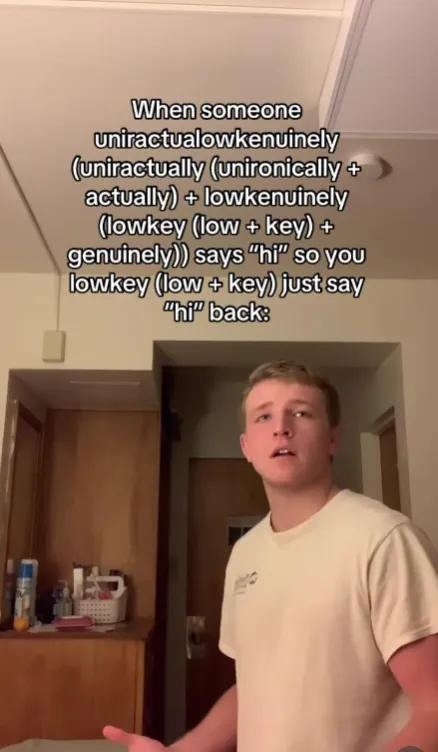
The actual morphology breakdown:
[UN] + [IRONIC] + [ACTUAL] + [LOWKEY] + [GENUINE] + [LY]
(I mean, he was close...)
un and ly are affixes with their own meanings:
[un-] → “not”
[-ly] → “in a certain manner”
These are morphemes as they hold meaning, but they're the subtype that cannot be used alone without a root.
Suffice to say that modern memes are odd.
There are no specific sources cited so I'll say it's all "theoretical" because I'm lazy. However, this is basic linguistics. I can give credit to my favorite linguistics textbook back in college for introducing morphology and sociolinguistics. The Language Files from Ohio State University which is on its 13th edition. I used the 12th edition, and still have it in my room.
Further reading if you're curious:
Wikipedia is a good resource for linguistics, surprisingly.
Video by Tom Scott on infix expletives
Davis, Chloe O. "The Language of Ballroom." The Gay & Lesbian Review, 9 Mar. 2021, glreview.org/the-language-of-ballroom/.